
Description
Notice for Purchase
1.The domes for PHONAK that we sell are official genuine products, not imitations, so the price is higher compared to counterfeit products.
2.We strongly recommend that you measure to get the right size before placing an order. You can place your existing dome on a ruler to measure it.
3.If you are unsure about the size you need, we recommend purchasing a mixed size pack (2 Domes for each specification). After that, you can determine the correct size you need for future purchases.
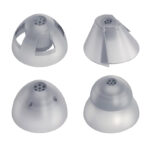
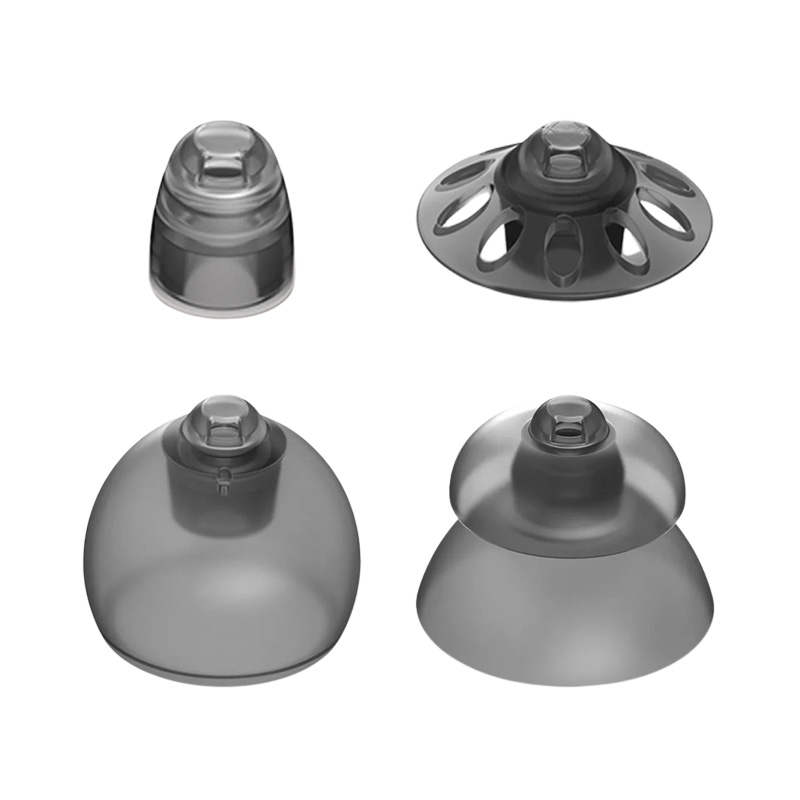
Type Differences
| Type | Degree of Ear Canal Occlusion | Low-Frequency Retention | Natural Sound Entry | Occlusion Sensation | Feedback Resistance | Typical Applications |
|---|---|---|---|---|---|---|
| Cap | Most open / minimal contact | Lowest | Highest | Minimal | Relatively low | Near-normal low-frequency hearing with mainly high-frequency hearing loss |
| Open | Very open | Low | High | Very mild | Relatively low | Typical high-frequency hearing loss with relatively good low-frequency hearing |
| Vented | Moderately occluding | Moderate | Moderate | Mild to moderate | Better | Some low-frequency hearing loss requiring additional gain |
| Power | Most occluding | Highest | Lowest | Most noticeable | Highest | Moderate-to-severe hearing loss requiring higher gain |
Explain the differences in detail
1. Cap Dome
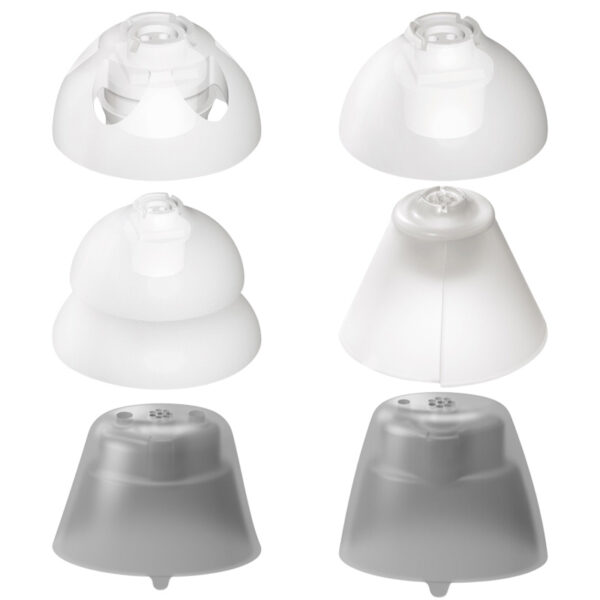
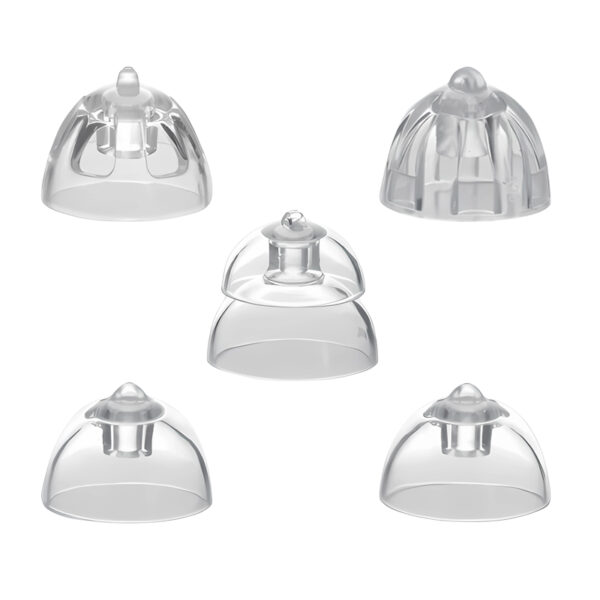
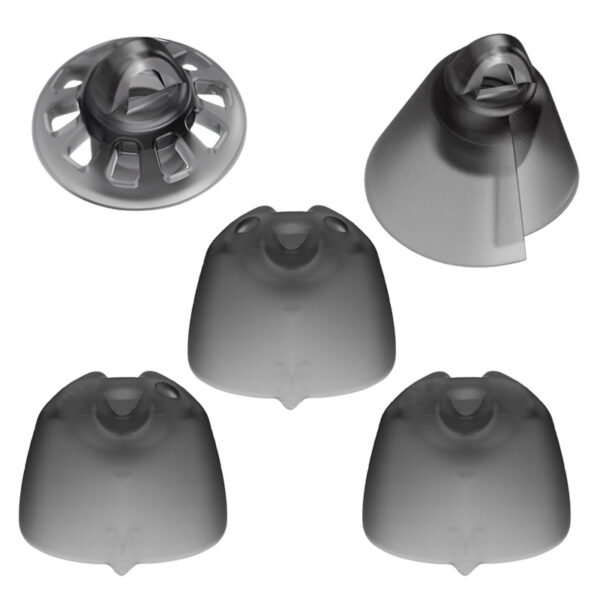
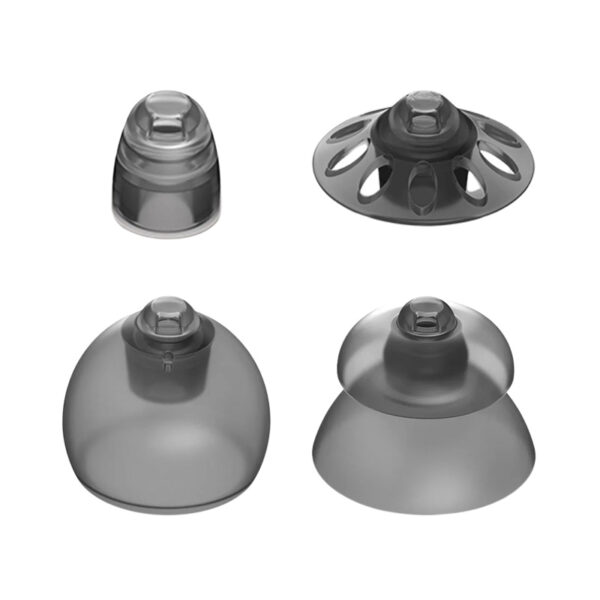
Among the four types, the Cap Dome is the smallest and provides the least occlusion. Phonak professional materials describe the Cap Dome as the smallest dome with minimal blockage of the ear canal. When worn, it provides a sensation closest to “having almost nothing in the ear.” It is mainly intended for people whose low-frequency hearing is normal or near normal, but who have mild to moderately severe hearing loss in the higher frequencies.
Its greatest advantages are comfort and ventilation. Low-frequency sounds that the wearer can still hear naturally are able to enter the ear canal directly. As a result, the wearer’s own voice usually does not sound excessively muffled or create the sensation of “talking inside a barrel.”
The trade-off, however, is also significant. Because amplified sound can easily escape from the ear canal, the hearing aid has difficulty providing substantial effective low-frequency gain. When high-frequency gain is increased considerably, acoustic feedback, or whistling, is also more likely to occur.
A typical audiogram suitable for a Cap Dome would therefore look like this:
250–500 Hz: near-normal hearing, with progressively greater hearing loss from 1–8 kHz.
For example, low-frequency thresholds may be around 15–25 dB HL, while thresholds at 2–4 kHz may have declined to approximately 40–60 dB HL.
2. Open Dome
The Open Dome is a very common type of dome used with RIC hearing aids. Phonak SDS materials classify it as an open fit, and it is commonly available in S, M, and L sizes.
It normally contains several relatively large openings. These openings allow air, environmental sounds, and sounds that the wearer can still hear naturally to enter the ear canal directly.
For this reason, the Open Dome is particularly suitable for the classic “steeply sloping high-frequency hearing loss” pattern:
Better low-frequency hearing → progressively poorer high-frequency hearing.
For example:
250 Hz: 20 dB
500 Hz: 25 dB
1 kHz: 35 dB
2 kHz: 50 dB
4 kHz: 65 dB
In this situation, using a closed dome may make low-frequency sounds seem muffled, boomy, or overly heavy. An Open Dome, by contrast, allows the wearer’s naturally audible low-frequency sounds to enter the ear canal while allowing the hearing aid to focus primarily on amplifying the mid and high frequencies.
Its main advantages are:
More natural sound quality, minimal occlusion sensation, a more natural perception of one’s own voice, and generally easier adaptation for first-time hearing-aid users.
Its disadvantages are limited low-frequency gain and an increased risk of acoustic feedback as the required gain rises. Therefore, if there is already significant hearing loss at 500 Hz, or even at 250 Hz, an Open Dome is often no longer the optimal choice.
Phonak professional materials also indicate that Cap Domes and Open Domes are better suited to people with normal or near-normal low-frequency hearing and mild to moderately severe hearing loss in the higher frequencies.
3. Vented Dome
The Vented Dome can be regarded as an intermediate option between an Open Dome and a Power Dome.
Phonak SDS materials define it as a semi-occluded fit. Compared with an Open Dome, its ventilation openings are smaller, allowing more of the hearing aid’s amplified output to be retained in the ear canal. At the same time, it is not as fully occluding as a Power Dome.
Its characteristics are therefore relatively well balanced:
It preserves some natural sound while providing noticeably greater low- and mid-frequency gain than an Open Dome.
It is especially suitable for people who already have some degree of low-frequency hearing loss, but whose hearing loss is not severe enough to require complete occlusion of the ear canal.
For example:
250 Hz: 35 dB
500 Hz: 40 dB
1 kHz: 45 dB
2 kHz: 55 dB
4 kHz: 65 dB
With this type of hearing loss, if an Open Dome is used, much of the amplified sound needed around 500 Hz may leak out of the ear canal, making it difficult to achieve the prescribed target gain. Switching to a Vented Dome can make it easier to reach the fitting targets.
Phonak professional materials describe Vented Domes and Power Domes as being more suitable for people with mild to moderate low-frequency hearing loss and hearing loss that may reach the severe range in the higher frequencies. They also indicate that the Vented Dome can serve as a practical general-purpose starting point in many fittings.
Its disadvantage is that the occlusion sensation may be slightly greater than with an Open Dome, and the wearer’s own voice may sound somewhat deeper or more muffled.
4. Power Dome
The Power Dome can be understood as the most occluding type among standard, non-custom domes. Phonak SDS materials classify it as an occluded fit.
It usually uses a double-flange or similar structure to create a substantially tighter seal in the ear canal.
Its most important function is not simply to “make the sound louder,” but rather to:
Reduce the amount of amplified sound that leaks out of the ear canal.
This is extremely important for people who require high levels of gain.
For example, if a hearing aid needs to provide substantial gain at 500 Hz but the dome is very open, much of the amplified sound may escape from the ear canal. On the one hand, the wearer may not actually receive the required gain. On the other hand, the escaped sound may be picked up again by the hearing aid microphones, causing acoustic feedback or whistling.
By providing a tighter seal, the Power Dome can offer:
Greater effective low-frequency gain, higher overall usable gain, and a larger feedback-stability margin.
It is therefore generally more suitable for moderate, moderately severe, and in some cases severe hearing loss.
For example:
250 Hz: 50 dB
500 Hz: 55 dB
1 kHz: 60 dB
2 kHz: 70 dB
4 kHz: 75 dB
For this degree of hearing loss, an Open Dome may not be able to deliver the prescribed gain effectively, making a Power Dome a more appropriate choice.
The disadvantages are:
The strongest occlusion sensation among the four types, a heavier or more muffled perception of one’s own voice, and more noticeable internally generated sounds while chewing or walking.
Therefore, if such a high level of gain is not required, there is generally no need to switch to a Power Dome simply in the hope of making speech sound “clearer.”
Additional information
Customer Reviews
2 reviews for PHONAK Domes
Related Products
HANSATON Hearing Aid Domes
Price range: US$18.90 through US$19.90Oticon MiniFit Receiver Domes
Price range: US$18.90 through US$19.90
PHILIPS Hearing aid Domes
Price range: US$18.90 through US$19.90
ReSound Domes (GN Hearing) Eartips
Price range: US$16.90 through US$19.90
Signia connexx Domes 2.0
US$19.90

Olivia Bennett –
I wasn’t sure which type of dome I needed, so I contacted the seller for advice. The seller was very helpful and patiently guided me in finding the right dome for my needs. I’m very grateful for the seller’s assistance.
Nathan Collins –
It’s genuine PHONAK domes
Happy New Year